Early in 2004, the United Nations Electronic Trade Documents (UNeDocs) standard message structure was announced as a project of the United Nations Economic Commission of Europe (UNECE) to develop and implement a set of aligned documents in paper and electronic format, especially as they suggest that the
production of the “necessary” documentation can be up to 10% of the product cost.
The paper and electronic documents are based on international documentary standards and on best business practice. UNeDocs paper and electronic documents are based on a common data model. This common data model ensures that the paper and electronic documents are a different implementation of a common document concept. This link ensures that traders can at any time choose the type of document technology that best meets their business requirements and technology capabilities.
SITPRO, the UK’s Trade facilitation body, has supported the United Nations in developing the documentary standards, which are the basis of today’s global trading system, such as the United Nations Layout Key (UNLK), the United Nations Trade Data Element Directory (UNTDED), UN/EDIFACT and a number of international
recommendations on the use of codes for trade data.
In supporting the delivery of UNeDocs, SITPRO and the United Nations started a project to develop a UNeDocs-UK toolkit of international trade documents. The documents of the toolkit are aligned to international standards and can integrate into latest XML based Internet technologies as well as into UN/EDIFACT or on paper.The generic UNeDocs documents can be translated and adapted to national requirements to build national sets of aligned trade documents.
Formwise Export
regards this project, to create a set of guidelines for electronic documents, to be potentially as important as the launch of the SITPRO aligned series of documents. We therefore face a possibility of sending email attachments which our partners can both view as documents, and if their systems are so enabled, facilitate the extraction and reading of the contained data into their own business control software.
It is unfortunate that this project will not continue as a national
project following the demise of SITPRO and their Document Working Taskforce.
We were members, were working to produce a UK e-Documents set, and, had already produced the necessary formats for both Export Cargo Shipping Instruction and Invoice data, which, with the appropriate style sheet, can be viewed as the document either through Internet Explorer, Word or Excel. Further documents will follow in due course.
Given that the national driving force has been removed, then we think that the sending of documents as Portable Document Formats (PDF’s) will remain the standard, but those companies with suitably enabled software could embrace this technology as a further way of moving documents electronically, and you can rest assured that Formwise will be expanded as soon as possible to have the capability of producing these documents.
Given that this technology
is available for home despatch/invoice production, there is also the possibility of using these files as transfer files to be read by Formwise to save the re-keying of data. Initially we will be concentrating on the creation of documents for sending to other parties with the reading options to follow.
One such system has already been developed and is working successfully.
This is a developing area of software in that data written under the (XML) eXtensible Mark up Language can be both a forms design and the data, which software can be configured to extract and read as a convenient human and systems integration interface.
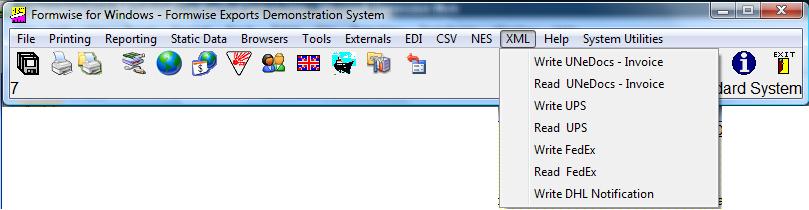
The first two options on this menu are to write and read the UNeDocs(UK)
Invoice Message, from which all documents can be derived. However the message format is still in its draft stage. As soon as it is finalised we will be contacting all users, other shippers and forwarders, to ensure they know that transferring data from one to another is possible.
The next pairs of options relate to passing information between the Courier Service Providers. The methodology is that you can
1. prepare the normal documents in Formwise, and then
2. output a file of that data into a give location on your computer, which is then
3. picked up by the Courier's software and read in and the shipment booked on-line
4. a tracking number is then allocated and output, for
5. you to run the Formwise up date routine, which will add the Courier's Tracking Number to the consignment record.
We expect to develop an interface to DHL's new IntraShip product so that they too can pick up data entered into Formwise without re-keying it into the courier's software.
Also one of our users is in negotiations with TNT for similar procedures.
If you have a trading party in mind, and would like to activate any of these option, please contact us on the
Support Line
This suite of options is not included within the
EASI range of systems.